On this page
The numbers 1:1:1, 1:2:2 and 1:4:4 appear constantly in sourdough guides. They aren't baking temperatures or secret fermentation codes. They describe how much existing starter, flour and water go into each feeding—by weight. Understanding the ratios lets you build exactly enough starter for a loaf, prevent an enormous jar from growing indefinitely and time your starter so it is ripe when you want to mix dough.
What the three numbers represent
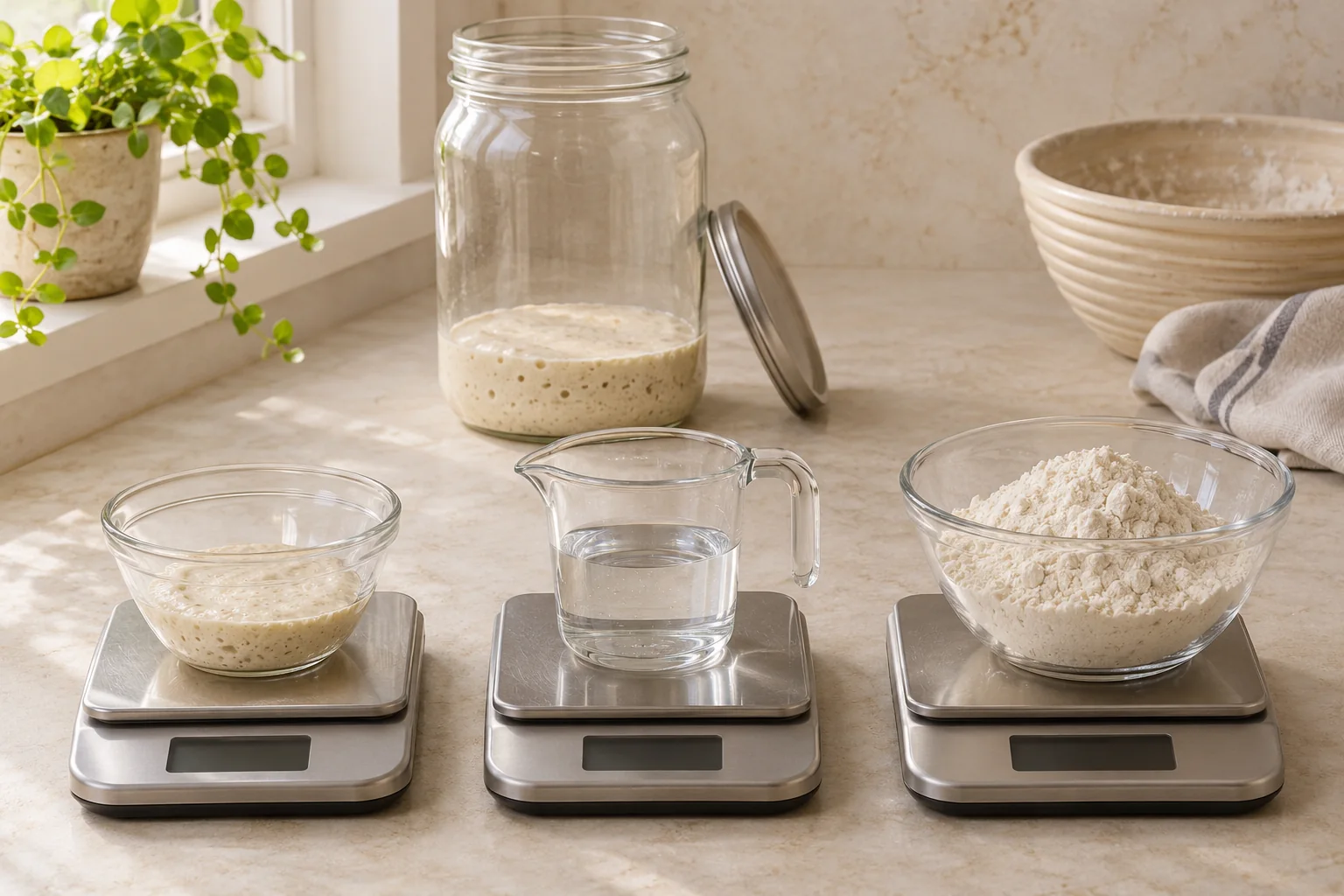
Most starter feeding ratios are written as starter:flour:water, although some sources explicitly list starter:water:flour. When the last two numbers are equal, the order doesn't affect the result. A 1:2:2 feed means one weight unit existing starter, two weight units flour and two weight units water. Use a scale; volume measures of flour and water aren't equivalent.
Understanding 100% hydration
A starter with equal total flour and total water weights is described as 100% hydration. A 1:1:1 feed maintains that balance when the seed starter is itself at 100% hydration. Feeding ratio and hydration are related but different concepts: a 1:4:4 feeding can also yield a 100%-hydration starter.
A 1:1:1 example
Keep 30 g mature starter, add 30 g flour and 30 g water. The result is 90 g of freshly fed starter. At a suitable warm temperature, a vigorous culture may peak within several hours.
A 1:2:2 example
Keep 20 g mature starter and add 40 g flour and 40 g water. You now have 100 g. Because there is more fresh food relative to the seed, the mixture often takes longer to reach peak. This can fit a schedule where you want starter later in the day.
A 1:4:4 example
Keep 15 g starter and add 60 g flour and 60 g water to make 135 g. It is a larger refreshment with fewer microorganisms per unit of new food at the start. The mixture usually takes longer to mature, which can be useful for an overnight schedule. Actual timing varies with temperature and culture strength.
How to calculate any ratio
Add the parts together, divide the desired final starter weight by that total, then multiply each part. For 180 g at 1:2:2, five total parts means 36 g per part: 36 g seed, 72 g flour and 72 g water. This is useful when you need a precise amount without producing a large excess.
Plan a reserve for future baking
If your bread recipe calls for 200 g starter, build more than 200 g so a small amount remains for maintenance and for what sticks to tools. For example, a final 250 g build at 1:2:2 would use 50 g seed, 100 g flour and 100 g water. Reserve enough for the next feeding rather than scraping your culture down to nothing.
Recipe to try: Sourdough Country Loaf. The loaf calls for active starter. Check its maturity and the dough’s fermentation cues before moving on to shaping.

Why larger feedings often peak later
More new flour and water relative to the seed means the microbial population starts less concentrated. It typically needs more time to ferment the greater fresh supply.
What temperature does to the ratio
The same ratio can mature much faster in a warm room than in a cooler one. Feeding ratios are a scheduling tool, not a guarantee of exact hours. Make notes of both the ratio and the temperature before deciding you need another formula.
Why you might choose 1:1:1
It is simple to remember, wastes little flour when maintained in a small quantity, and can produce a reasonably quick peak in an active culture. It is often a good starting ratio when you're learning the culture's behaviour and can feed frequently enough.
Why you might choose 1:2:2
It gives the starter a relatively larger refreshment and commonly delays peak compared with 1:1:1. This can help if a morning feeding must remain active until an afternoon baking window. Evaluate your starter under your conditions rather than assuming the clock will match someone else's.
Why you might choose 1:4:4
It can be useful for a longer wait before using starter, such as overnight, because it supplies relatively more fresh flour. However, a very young or weak culture might not rise predictably on a large ratio. Build basic strength first and then adjust for scheduling.
Do larger ratios make starter healthier?
A suitable feeding schedule supports a healthy culture, but larger is not automatically better. A starter fed infrequently in a warm kitchen may exhaust its food, while one given a very large meal and kept cold might take a long time to show activity. Match feeding amount and frequency to temperature and baking plans.
Why keeping a small mother starter helps
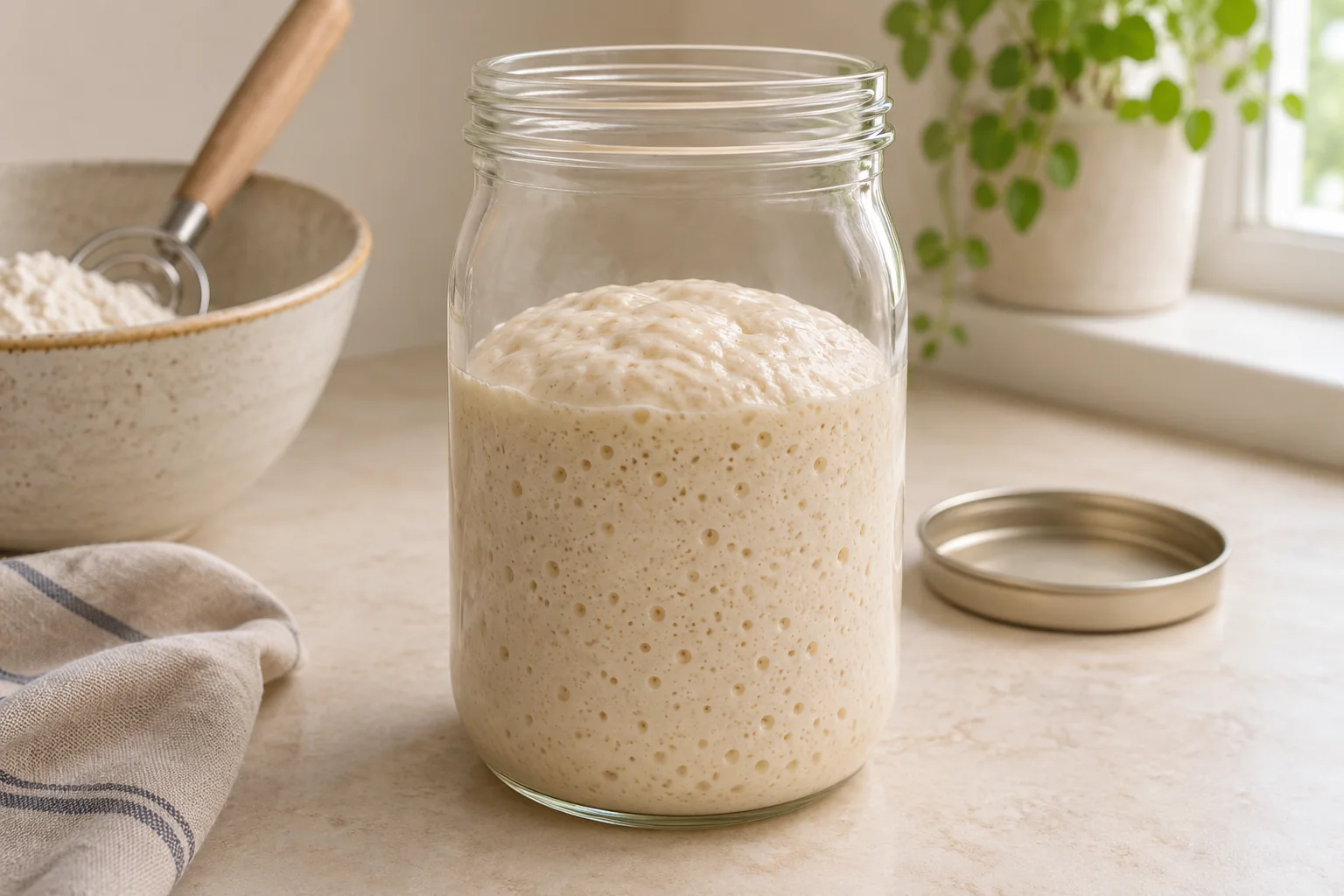
You need surprisingly little old starter to build the amount required for a loaf. Maintaining 20–50 g rather than a huge container can reduce flour waste. Just calculate a larger final feed when needed. Use a clean jar with plenty of headroom for rise.
Discard is about controlling size
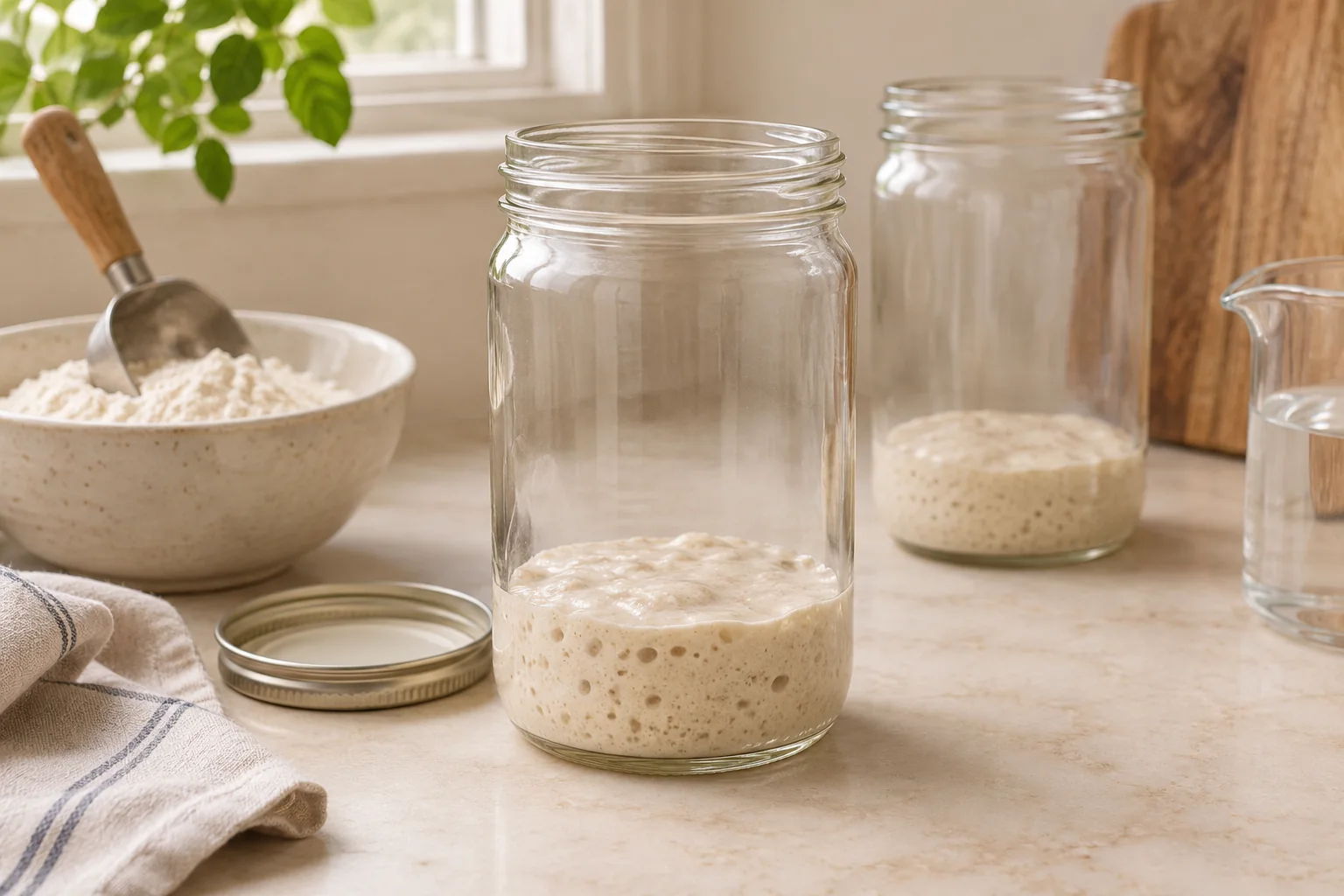
Without removing some old starter, each feeding increases the total quantity quickly. Discard maintains manageable volume and balances old fermented material against fresh flour and water. It isn't an admission that you have failed at baking. Once a healthy established starter is maintained, certain discard can be used in recipes developed for it.
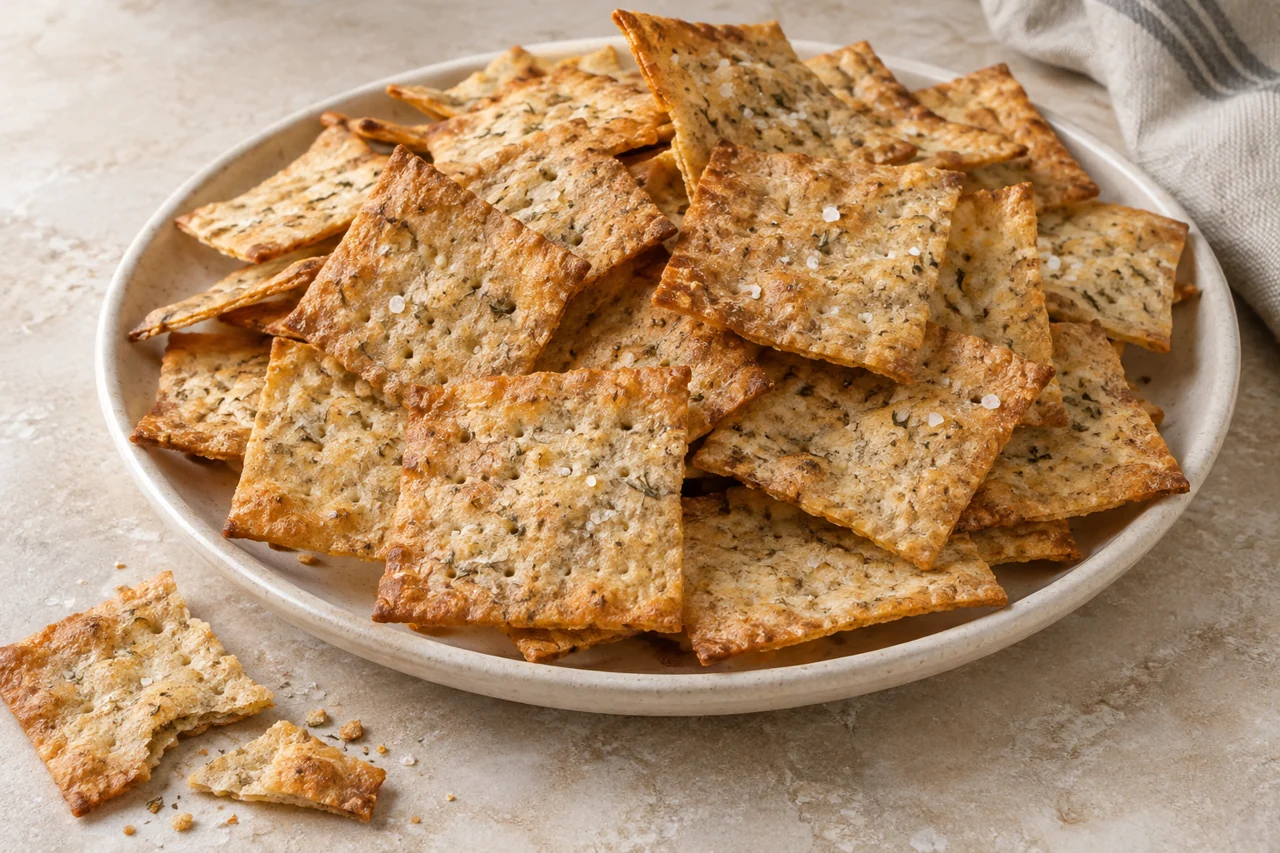
Recipe to try: Sourdough Crackers. These crackers use sourdough discard. Use discard from a healthy established starter and bake it fully; this is not a raw-starter snack.
Don't confuse weight and cups
One cup of water weighs substantially more than one cup of flour, and a cup of foamy starter varies with gas content. Feeding one cup starter with one cup flour and one cup water is not 1:1:1 by weight. A digital scale makes ratio calculations far more reliable.
Changing the flour mix
Whole wheat and rye can make starter behave differently from white flour. Some bakers blend flours to support activity or flavour, but a flour change can alter peak timing. Keep the feed weights consistent and observe several cycles before judging whether the ratio adjustment worked.
Changing starter hydration
A stiff starter has proportionally less water than a liquid starter, so a feeding formula may not use equal weights of flour and water. Be sure you know whether your bread recipe specifies a 100%-hydration levain, a stiff levain or another preparation. Feeding ratio notation alone doesn't always describe total hydration.
How to troubleshoot a slow feed
Check the room temperature, current culture activity, seed quantity and flour quality. A larger ratio can be slower even when the culture is healthy. If there is no rise over repeated consistent feedings, consider whether the starter needs rejuvenation before switching ratios repeatedly.
How to troubleshoot a feed that peaks too early
A small ratio in a warm kitchen may peak and collapse before the next planned feed. Consider a larger refreshment or a cooler appropriate location as described in starter-maintenance guidance. Keep careful notes and don't confuse a fallen starter with one that never rose.
A simple reference table
1:1:1: equal seed, flour and water; common for routine feeding. 1:2:2: twice as much fresh flour and water relative to seed; often a later peak. 1:4:4: four times each; often later still. These are scheduling tendencies, not fixed laboratory results across all kitchens.
Frequently asked questions
Is 1:2:2 stronger than 1:1:1? Not inherently; it changes the refreshment and timing. Does 1:4:4 mean 400% hydration? No, equal flour and water can still be 100% hydration. Should I always discard before feeding? It depends on whether you're maintaining size or deliberately building more starter. Are ratios based on cups? No—use weight.
Recipe to try: Sourdough Ciabatta. Ciabatta provides a different dough and loaf shape to practise with. Keep its hydration and handling instructions together.

Make the numbers work for you
Once you understand the arithmetic, you can feed a tiny starter, build the exact amount needed for a recipe and choose a ratio that fits your day. Observe its actual rise and temperature, then refine the schedule. That is much more dependable than copying an exact feeding hour from someone else's kitchen.
IN PICTURES
From the baking notebook
FROM THE RECIPE BOX


