On this page
A homemade cookie box is a lovely way to send someone a little piece of your kitchen. But a cookie that looks beautiful on a dessert platter may not survive a few days of sorting facilities, delivery trucks and bumpy handling. The best cookies for mailing are sturdy, shelf-stable and packaged so they cannot move around.
You do not need a professional bakery setup. You do need to choose the right recipes, cool everything completely, separate different textures and protect the cookies inside a strong shipping carton. Here's how to make a thoughtful cookie package that has a better chance of arriving in one piece.
Quick answer: Start with thick shortbread, biscotti or sturdy gingerbread. Pack each kind separately in food-safe, airtight bags or containers. Cushion those containers inside a rigid box, avoid fillings that need refrigeration, and check your carrier's current rules and delivery schedule.
Which cookies travel best?
Cookies that mail well don't necessarily need to be hard. They do need enough structure to survive vibration and pressure, and they should taste good after the expected journey. A cookie's exact recipe, thickness, icing and climate all make a difference.
1. Biscotti: a dependable long-distance choice
Biscotti are baked twice, giving them a relatively dry, crisp texture that is well suited to gifting. Their shape makes them easy to line up neatly, although the ends can snap if they rattle around. Pack them flat in a snug, airtight food-safe bag with support around the edges.
Best for: Longer domestic journeys, coffee lovers and boxes assembled in advance.
2. Thick shortbread: simple, buttery and sturdy
Shortbread rounds, fingers and thicker bars tend to be easier to ship than thin cutouts. Their tender texture still calls for padding, but they're straightforward to portion and protect. Choose a recipe with firm finished cookies rather than especially delicate, crumbly pieces.
Best for: Classic gift boxes, tea-time assortments and uncomplicated packaging.
3. Gingerbread cookies: festive without fragile decorations
Gingerbread is a natural choice for Christmas mailing. For cutouts, thicker shapes generally hold up better than thin stars with narrow points. Sugar or sprinkles baked onto the cookies travel more predictably than intricate, raised icing details.
Try our Gingerbread Cookies Recipe as a starting point. For mailing, consider simpler decorations and evaluate how sturdy the finished cookies feel once cool.
Best for: Seasonal parcels, cookie exchanges and family gifts.
4. Small, well-baked drop cookies: choose the texture carefully
Chocolate chip, peanut butter and oatmeal-style cookies can travel well when they're fully baked, cooled and not extremely soft or fragile. Smaller, evenly sized cookies are easier to pack securely than giant bakery-style cookies. Keep chewy cookies away from crisp biscotti so their moisture doesn't soften the crisp ones.
For inspiration, see our Brown Butter Chocolate Chip Cookies or Peanut Butter Chocolate Chip Cookies. Follow the recipe's baking guidance and choose pieces sturdy enough for transit; don't intentionally underbake cookies you plan to mail.
Best for: Familiar crowd-pleasers when shipping time is short.
5. Sandwich cookies and festive crinkles: possible, with extra care
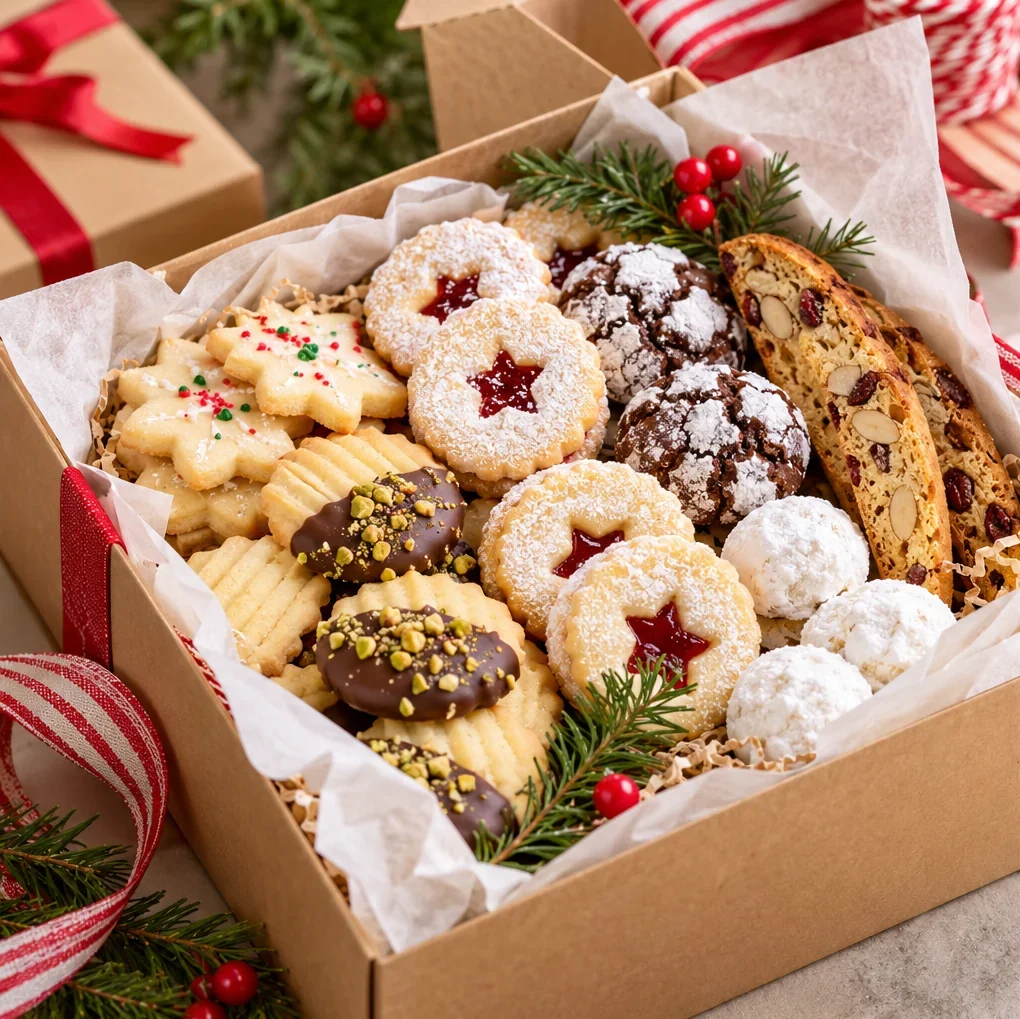
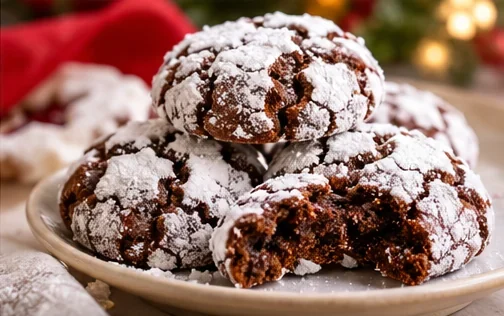
A well-set, shelf-stable jam sandwich cookie or chocolate crinkle can look wonderful in a Christmas assortment. They're not automatically as reliable as biscotti: jam can transfer moisture or stick, powdered coatings may rub off, and soft crinkles may flatten. Protect these individually or in small flat groups, and reserve especially delicate versions for hand-delivered gifts.
Which cookies should you avoid mailing?
Some treats need a short drive across town, not a trip through the postal system:
- Cookies with fresh cream, custard, cream cheese frosting or other refrigeration-dependent fillings. Standard unchilled parcel shipping is not appropriate for food that must remain cold.
- Very thin lace cookies, delicate wafers and fragile meringues. They are prone to breaking, particularly in humid conditions.
- Decorations that stand up from the cookie. Tall piped details and brittle sugar ornaments may crack or transfer to nearby pieces.
- Sticky, soft-centred or very delicate cookies. They can deform or stick together inside a warm box.
- Chocolate-heavy coatings in hot weather. Melted chocolate can smear even when the cookie itself is structurally sound.
When in doubt, choose a simpler recipe or arrange hand delivery. Packaging cannot make a perishable filling shelf-stable.
What you'll need to mail homemade cookies
You don't need an elaborate gift hamper, but each layer of packaging has a job:
- Food-safe inner packaging: Sealed bags, appropriate lidded containers, or tins with airtight inner bags.
- Parchment paper: To separate cookie layers or keep shapes from rubbing against one another.
- A rigid outer shipping box: Strong corrugated cardboard that comfortably fits the protected inner containers.
- Cushioning: Crumpled paper, air pillows or bubble wrap around the sealed food packaging, never touching unwrapped cookies.
- Tape and a clear mailing label: Seal all seams and check the recipient's address.
Packaging materials should not create pressure that crushes the cookies, but neither should the contents have room to slide around.
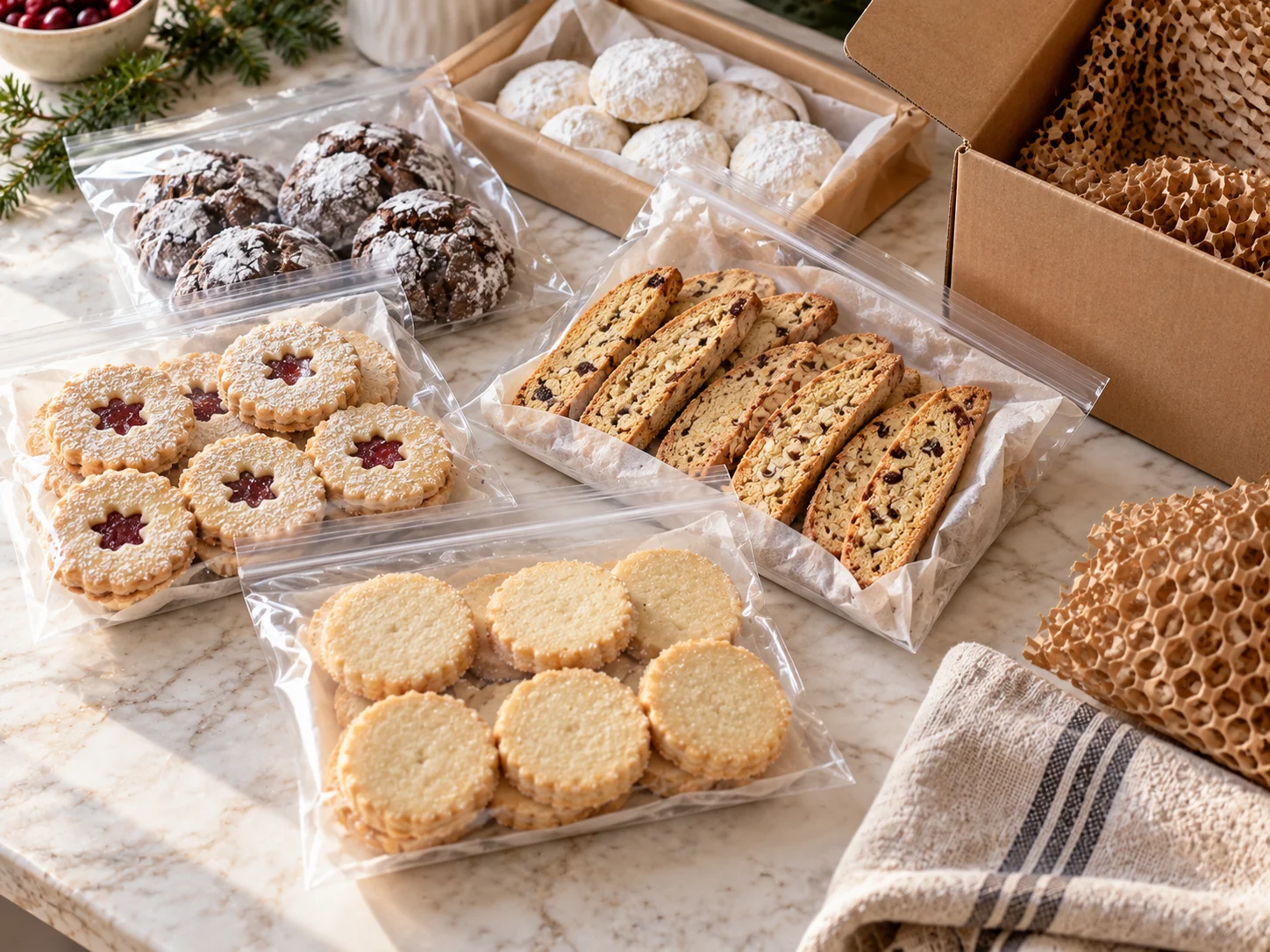
How to pack cookies for shipping, step by step
Step 1: Cool cookies completely
Even slightly warm cookies can release moisture into a closed bag. Place them on a rack until they are fully cool; let any glaze or icing set completely. Avoid sealing cookies while they're still steaming.
Step 2: Sort by texture, flavor and sturdiness
Keep crisp biscotti separate from soft chocolate chip cookies. Moisture migrates between different cookie types, gradually making crisp cookies softer and chewy cookies drier. Keep strongly spiced or peppermint-flavored treats apart from delicate vanilla cookies, too.
Step 3: Pack in snug, airtight groups
Use small food-safe bags or containers so cookies cannot slide around. Arrange flat cookies in one layer or, for sturdy styles, two well-supported layers separated with parchment. Pair similarly shaped cookies back-to-back when appropriate. Don't cram different shapes together simply to fill space.
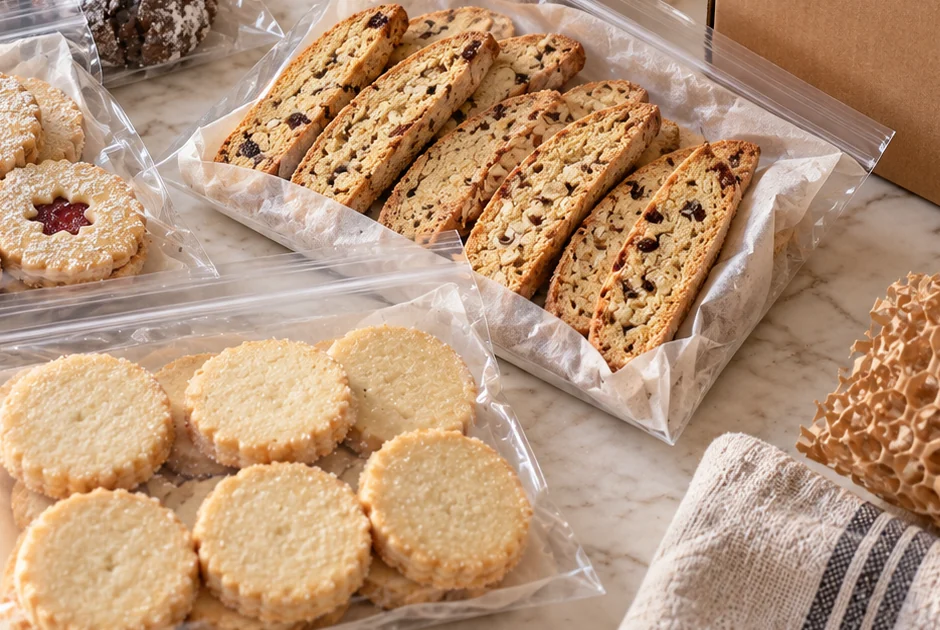
Step 4: Add a protective inner container
Place the sealed bags in a sturdy cookie tin or small rigid box. This extra barrier matters especially for fragile edges. A decorative gift box is lovely, but its appearance does not replace its structural purpose.
Step 5: Cushion the shipping carton
Line the bottom of a strong outer box with padding. Position the inner container centrally and fill space at the sides and top so it stays put. Keep non-food cushioning outside the food-safe packaging.
Step 6: Do a gentle movement check
Close the shipping box without taping it. Carefully tilt and gently move it: if you can feel the inner container shift, add protection. Seal securely after the contents feel stable.
Step 7: Choose the dispatch date carefully
Look at the actual delivery estimate, weekends and weather. Shipping early in the week may reduce time spent waiting through a weekend. Faster service can help with freshness, but it cannot guarantee a specific arrival condition. Always check restrictions for your destination and carrier, especially for international mail.
A practical Christmas cookie box that travels well
For a manageable assortment, choose three different textures or flavors, rather than ten delicate varieties:
- Buttery shortbread: Make it the sturdy foundation of the box.
- Spiced gingerbread: Adds holiday flavor and recognizable shapes.
- Crisp biscotti: Offers contrast and stays satisfying alongside a warm drink.
If the journey is short, swap in a small, well-baked chocolate chip cookie. Place every variety in its own inner bag. For recipients with allergies, check ingredients, avoid cross-contact and label common allergens clearly; don't claim anything is allergen-free without appropriate controls.
How long before mailing should you bake the cookies?
Work backward from your carrier's current estimated transit window and each recipe's storage instructions. Many sturdy cookies can be baked a little ahead, but there isn't one safe, universal number of days for every homemade cookie. The ingredients, moisture, packing, heat and time in transit all matter.
A practical sequence is to bake your longer-keeping cookies first, let all varieties cool fully, package them in airtight groups and send the finished parcel as soon as practical. Do not assume a fast service is temperature-controlled.
Troubleshooting: what went wrong with the cookie package?
My cookies arrived broken. Choose thicker shapes next time, reduce the number of loose layers, and cushion the inner containers so they can't shift.
My biscotti or gingersnaps went soft. They may have picked up moisture from softer cookies or been sealed before fully cooling. Pack crisp and chewy styles in separate airtight bags.
The icing rubbed off. Let decorations dry completely before packing and avoid high, fragile designs. Sprinkles baked into dough are often sturdier than elaborate icing.
Everything tasted stale. The travel time may have been too long for the recipe, or the inner packaging wasn't airtight. Choose recipes that keep well and aim for a shorter delivery window.
The gift box looked untidy on arrival. Keep decorative ribbon and tissue outside airtight food packages, and use a snug inner container instead of letting cookies sit loose in the shipping carton.
Frequently asked questions
Can you mail homemade chocolate chip cookies?
Yes, many fully baked, sturdy chocolate chip cookies can be mailed in airtight, protected packaging. Very soft or extremely large cookies need more support and are less predictable in transit.
Can you mail cookies with royal icing?
You can mail suitable shelf-stable iced cookies once the icing has completely dried and the decorations are flat enough to protect. Delicate piped details remain a breakage risk; check the ingredients if the icing or filling requires refrigeration.
Should you freeze cookies before shipping?
Freezing can be useful for make-ahead baking if the recipe freezes well, but it doesn't guarantee the cookies will remain frozen during ordinary transit. Thawing and condensation can affect decorations and texture. Plan for a shelf-stable room-temperature journey unless you're using an appropriate temperature-controlled shipping method.
Should different cookies go in the same bag?
Prefer separate bags for each variety, especially when one cookie is crisp and another is soft. Separate strong flavors such as peppermint or gingerbread from milder cookies as well.
Can you mail cookies from Canada to the United States?
The answer depends on the ingredients, destination, customs requirements and current carrier rules. Check the current Canada Post and destination-country requirements before packaging or paying for international postage; never assume every homemade food item is automatically allowed.
Choose a cookie for the journey, not just for the flavour
Mailing puts baked goods through movement, temperature variation and variable delivery times. A crisp shortbread biscuit can tolerate different handling from a jam sandwich or cream-filled cookie. Start with sturdy recipes that do not require refrigeration and are firm enough to survive carefully packed transport. For a holiday box, a combination of plain gingerbread, firm shortbread and selected drop cookies is more sensible than a box dominated by delicate buttercream sandwiches.
Our Gingerbread Cookies contain molasses and warm spices and can be baked into relatively firm shapes. The Brown Butter Chocolate Chip Cookies offer a familiar contrast but may be more delicate if oversized. Peanut Butter Chocolate Chip Cookies introduce peanuts, so they must be clearly labelled and avoided where the recipient cannot eat peanuts.
How to pack a box that won't rattle
Cool every cookie completely, then group similar shapes and textures. Wrap each group with food-safe materials, and place it inside a rigid container. Avoid loose stacks of different cookies rubbing together. Put the protected inner container inside a shipping carton and cushion every side with suitable packing material. The purpose is to prevent movement without compressing the cookies.
Do a gentle movement check before sealing. If the cookies or tin slide noticeably, adjust the dividers or protective packing. Do not use printed decorative paper or glitter directly against food. A handwritten note can be placed safely outside the food-contact packaging.
A holiday mailing schedule
Choose recipes and packaging well before baking day, then prepare only the number of cookies you can pack promptly. Baking early enough to cool and package completely is helpful, but leaving finished cookies on the counter for an extended period defeats the aim of sending fresh food. Dispatch as close to the intended delivery window as practical and consider weekends, holidays, weather and the carrier's published shipping estimates.
For international deliveries, examine current customs and food-import requirements for the destination before preparing the parcel. Do not assume homemade cookies can cross every border or that an ordinary shipping label satisfies the destination's import rules. Ingredients such as nuts or dairy may affect eligibility.
How to choose cookies when heat or cold is expected
High heat can soften chocolate and some fillings. Cold weather may help some products remain firm, but condensation during warming can affect decorations. Choose recipes that suit the likely route. Avoid perishable refrigerated fillings unless the shipping method can reliably maintain appropriate temperatures, which is not guaranteed by placing an ice pack in an ordinary parcel.
Chocolate chip cookies without fragile glaze may survive better than elaborate dipped sandwiches in warm weather. Gingerbread shapes need support at thin limbs or points. Thick shortbread fingers may be more robust than elaborate cut-outs. Think about physical shape as well as ingredients.
Food labels and special requirements
Include a list identifying the varieties and relevant ingredients or allergens. Wheat, milk, egg, peanuts and tree nuts are frequent concerns in cookie assortments. A peanut-butter cookie should never be tucked into a general assortment without clear identification. Shared baking equipment can lead to cross-contact; do not advertise a home-baked assortment as allergy-safe without appropriate ingredient and handling controls.
Shipping problems and practical answers
The cookies arrived broken
Try a sturdier cookie style and a smaller, better-fitted rigid container with dividers. Fragile cut-outs may need individual cushioning. An oversized tin inside a shipping box is not enough if the cookies can slide freely inside it.
Everything tastes like gingerbread
Strongly flavoured cookies can transfer aroma during storage. Separate spiced cookies from mild vanilla varieties in individual food-safe wrappers or compartments, especially on a multi-day journey.
The cookies arrived soft
Humidity, condensation or proximity to soft fillings may have affected the texture. Pack only fully cooled cookies and use suitable airtight materials. Do not try to ship perishable cream-filled cookies as if they were firm biscuits.
Selecting cookies for the mailing distance
A local hand-delivered box can include cookies that are more delicate than those sent through multiple sorting centres. For a mailed gift, choose sturdy shapes and fillings that do not require temperature-controlled transport. The value of a firm shortbread or plain gingerbread cookie is not simply its flavour: it is less likely to break or spoil during ordinary transit than a thin cookie with a cream filling.
Consider how long the package may be in transit. Avoid posting a fragile box just before a weekend or statutory holiday if that creates unnecessary days in transit. Check shipping dates directly with the carrier, since delivery times and import rules change. For international deliveries, verify the destination's requirements for homemade foods rather than assuming cookies can always cross a border.
Before mailing, perform a final packaging check. Each cookie group should be wrapped using suitable food-safe materials, placed in a rigid inner container and cushioned inside an outer carton. The cookies must not slide freely when the closed package is gently moved, but the protective material must not crush delicate edges.
Build a mail-friendly assortment around sturdy textures
Start with plain gingerbread or shortbread as the structural core of a box. Add one drop-cookie recipe for variety, provided the pieces are firm enough to pack without collapsing. A deeply chewy oversized cookie can be more vulnerable to pressure than a smaller, fully cooled cookie. For a festive appearance, choose simple shapes that do not have very thin arms or points.
A gift of three dependable varieties is often a better choice than a dozen delicate ones. The recipient will appreciate cookies that arrive intact and taste fresh more than an assortment with beautiful colours but broken pieces. Build the menu around the likely journey, including any time the parcel might sit in a warm vehicle or warehouse.
How to pack the layers of a shipping carton
At the first layer, wrap fully cooled cookies in small groups separated by texture and flavour. At the second, arrange those groups inside a clean food-safe box or tin with parchment or suitable dividers. At the third, protect the entire inner container inside a larger carton with cushioning on all sides. Each layer serves a different purpose: preserving freshness, preventing direct collisions, and absorbing external handling.
Before sealing, gently tilt the closed inner box. If the cookies slide or rattle, reduce empty space using food-safe dividers without pressing hard against fragile pieces. Then check that the outer shipping carton does not let the inner tin move freely. Do not add decorative paper directly against oily cookies unless it is appropriate for food contact.
Recipient instructions make the gift more useful
Include a small card identifying the different varieties, major allergens and sensible storage instructions based on the actual recipes. If the cookies contain peanuts, say so plainly. If they have a filling that requires refrigeration, the parcel may not be suitable for unrefrigerated transport at all. Avoid promising a universal seven-day or two-week shelf life: texture and safety depend on the ingredients and handling.
When sending a gift internationally, the sender must check current customs and food import rules for both countries, including the specific contents. A rule that allows packaged commercial biscuits may not necessarily allow a homemade parcel. Declare goods accurately and never mislabel food in an attempt to avoid inspection.
Questions to answer before paying for postage
Will the package arrive before the weekend?
Use the carrier's real delivery estimate for the mailing date, not a typical transit time remembered from another season. Holiday closures can extend shipping, and a homemade baked gift is more sensitive to delay than a nonperishable product.
Can I add buttercream sandwiches?
Only when their actual ingredients, required temperature and transport conditions make the trip appropriate. For ordinary mail without temperature control, a sturdy unfilled cookie is generally the more practical selection.
Should the cookies be frozen before mailing?
Freezing can be useful for advance preparation, but shipping frozen cookies without a reliable cold chain creates thawing and condensation concerns. Pack fully cooled, suitable shelf-stable cookies for conventional mail unless a tested alternative is appropriate.
Build a mailing menu based on physical durability
Biscotti, sturdy shortbread and firm gingerbread tend to be useful starting points because they can hold their shape with careful protection. That does not make them indestructible. A thin biscotti piece can snap when pressed against a heavier cookie, and a gingerbread figure with narrow arms can lose those pieces during transport. Choose shapes that fit the box, then arrange them so weight rests against protective packaging instead of other cookies.
Drop cookies deserve their own test. Some are relatively firm around the edges but have soft centres, while others are fragile when baked thin. Use a published recipe such as Brown Butter Chocolate Chip Cookies, cool the batch fully and test how it packs in a small container. Do not promise that an especially large cookie will remain perfect through a long postal journey without evaluating its texture.
How to protect crisp and soft cookies separately
Crisp cookies can soften when exposed to humid air or packed directly against soft, moist fillings. Separate different textures with appropriate inner wrapping rather than relying solely on the outer shipping box. A firm plastic or metal container can protect the arrangement from physical damage, but it should still be clean and suitable for food contact. A small food-safe paper liner can also help prevent rubbing between decorated surfaces.
Wait until chocolate coatings and icing are completely set. If the cookies are warm when sealed, trapped moisture can create condensation, softening the crisp varieties. On a cold-weather route, temperature transitions may create condensation when a package is brought indoors. Let the recipient know how to store the cookies and follow any instructions that apply to the actual recipe.
Choosing whether to use a cookie tin or a bakery box
A metal tin or sturdy rigid plastic container offers better physical protection than a flimsy paper box, though neither prevents breakage if the contents can move. A bakery box can be attractive for a hand-delivered gift but may need extra internal and external support for conventional shipping. Match the package to the cookie's size, weight and shape.
Put several cookies of similar size together so they can be held firmly without crushing. Use separate sections for strongly flavoured varieties, nut-containing cookies and those with chocolate coatings that might rub off. The box should be full enough to stop major movement but not compressed so that closing the lid breaks the cookies.
What to tell the person receiving homemade cookies
Identify the cookie types, major allergens and any special storage directions. State whether the box contains peanuts, tree nuts, wheat, eggs or milk where applicable. Homemade cookie gifts are often shared, so written identification helps recipients make informed decisions. If you cannot ensure an allergy-safe preparation environment, avoid making an unsupported claim that the assortment is free of cross-contact.
Include a friendly note explaining when the cookies were baked and that the recipient should follow any appropriate recipe-specific storage advice. If a cookie uses a perishable filling, reconsider the suitability of conventional shipping rather than relying on a label to make unrefrigerated transport safe.
A sample mailing-box packing inspection
Imagine sending twelve gingerbread cookies and twelve small chocolate-chip cookies. Cool both batches fully, then place each type in a separate food-safe inner package. Arrange them so the firmer gingerbread does not press into the softer chocolate pieces. Use parchment dividers to protect surfaces and a rigid outer food container to protect the arrangement. Add cushioning between that container and the shipping carton to reduce movement.
Check the box lid, gently tilt the parcel and listen for rattling. If pieces move freely, adjust the packaging rather than adding a heavier object on top of the cookies. Label the varieties, ingredients and any allergens. Finally, confirm the carrier's delivery window and destination rules before sealing and dispatching. Planning around the actual route is an essential part of making a mailed gift enjoyable.
Choosing between local delivery and shipping
When the recipient lives nearby, delivering in person is often simpler for delicate iced biscuits or filled treats because the journey is shorter and you can control handling. For long-distance deliveries, use sturdy recipes that can tolerate ordinary ambient transport and avoid fillings that require refrigeration. A cookie that cannot safely endure the delivery conditions should be replaced rather than shipped with unsupported assumptions about how long it will last.
Last-minute shipping decisions
Before preparing the final parcel, ask three questions. First, are all the cookies sufficiently sturdy and suitable for transport without refrigeration? Second, is the packaging snug and protective enough to prevent collisions and crushed edges? Third, has the sender checked the actual delivery estimate and any relevant destination restrictions? If one answer is uncertain, address it before shipping rather than relying on the parcel arriving quickly.
A well-chosen assortment needs only a few varieties. A small group of gingerbread, shortbread and chocolate-chip cookies can offer plenty of visual contrast while remaining easier to protect. Put fragile decorations aside for gifts that can be delivered in person if they are unlikely to survive the journey.
With baked goods, packaging is part of the recipe's success beyond the kitchen. Choosing sturdier shapes, cooling fully and sending them under suitable delivery conditions can make the difference between a thoughtful gift and a box of crumbs. Confirm the recipient's allergies and expected availability before dispatching.
The takeaway
For the best homemade cookie delivery, start with sturdy, shelf-stable cookies, wrap each variety for its texture, and prevent movement inside the shipping carton. Biscotti, substantial shortbread and gingerbread are excellent places to begin. A neat box and a handwritten note make the gift personal; thoughtful packing gives those cookies the best chance of arriving beautifully.
IN PICTURES
From the baking notebook
FROM THE RECIPE BOX