Perfectly Fried Eggs Recipe

Golden-yolked fried eggs with perfectly crispy edges and runny centers make for a simple yet sublime breakfast staple that's endlessly versatile.
Difficulty:
Beginner
Prep Time:
2 mins
Cook Time:
3 mins
Serves:
2 eggs
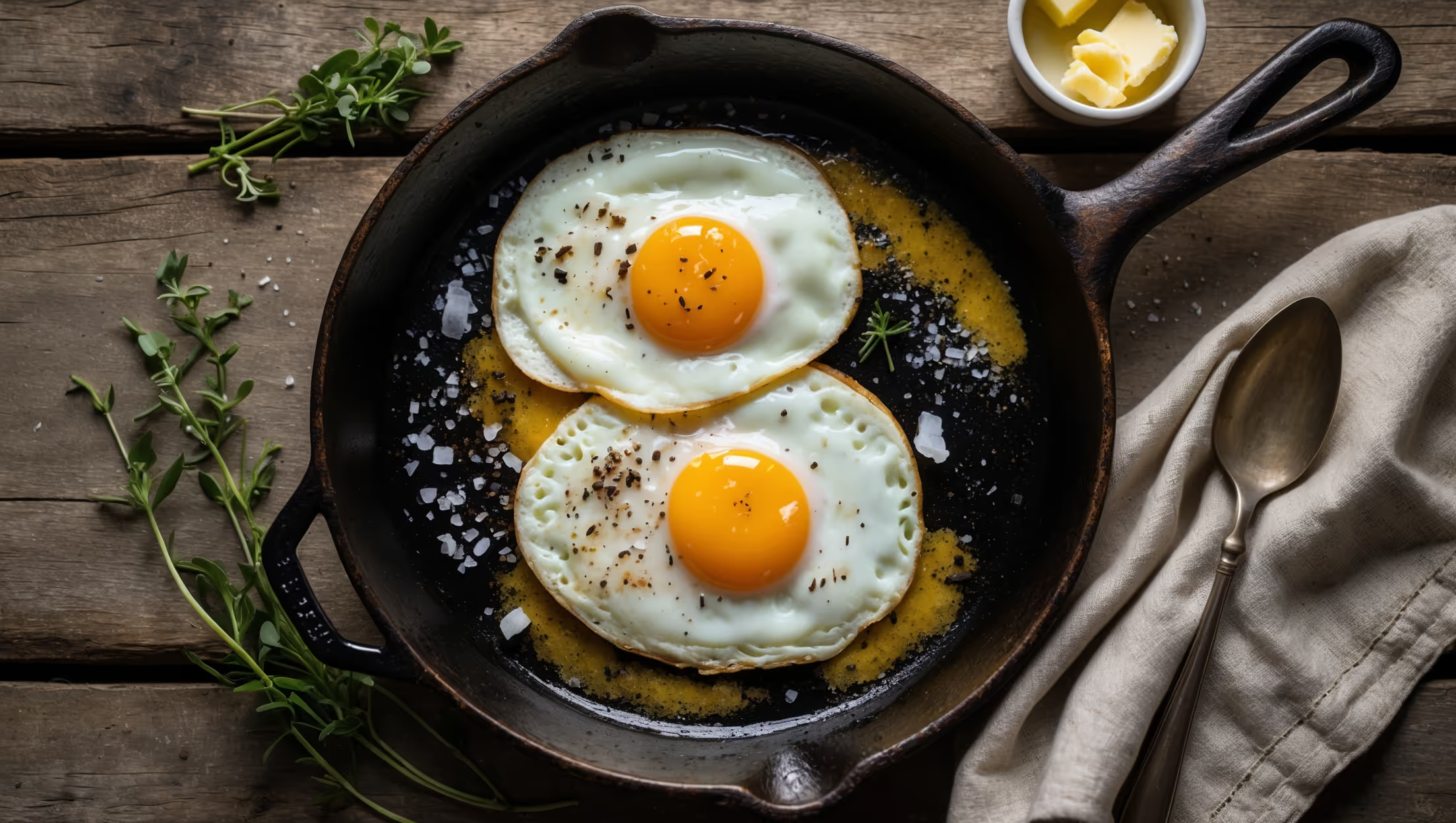
An overhead shot of two fried eggs on a rustic cast-iron skillet, their whites perfectly set with delicately crisp, golden-brown edges contrasting against vibrant orange-yellow yolks that glisten in the soft morning light. A sprinkle of flaky sea salt and freshly cracked black pepper adds texture and dimension, while a few sprigs of fresh herbs rest alongside. The skillet sits on a weathered wooden table with a folded linen napkin and small ramekin of butter nearby, creating a cozy breakfast scene that highlights the simple perfection of perfectly fried eggs.

Ingredients

<ul class="ingredients-main-list"><li class="ingredients-single-item">2 large eggs, at room temperature</li><li class="ingredients-single-item">15g unsalted butter</li><li class="ingredients-single-item">1 tbsp olive oil</li><li class="ingredients-single-item">Flaky sea salt, to taste</li><li class="ingredients-single-item">Freshly ground black pepper, to taste</li><li class="ingredients-single-item">Fresh herbs (optional, like chives, parsley, or thyme)</li></ul>

Equipment

<ul class="equipment-main-list"><li class="equipment-single-item">Non-stick or cast iron skillet</li><li class="equipment-single-item">Silicone spatula</li><li class="equipment-single-item">Slotted turner or fish slice</li></ul>
BAKE SMARTER

Kitchen Converter

Quickly switch between common baking units without leaving the recipe.

Convert
Result—

Volume uses US cups, tablespoons, and teaspoons. Converting weight to volume depends on the ingredient.

Directions

<ol class="no-list-style"><li class="MethodStepper"><h4 class="step-title">Step 1</h4>Remove your eggs from the refrigerator 15-20 minutes before cooking to allow them to come to room temperature. This prevents the cold eggs from causing the hot fat to splatter and ensures more even cooking.</li><li class="MethodStepper"><h4 class="step-title">Step 2</h4>Place a non-stick or well-seasoned cast iron skillet over medium heat. Add the olive oil and allow it to heat until shimmering but not smoking. The combination of butter and oil creates the perfect frying medium - oil raises the smoke point while butter adds flavor.</li><li class="MethodStepper"><h4 class="step-title">Step 3</h4>Add the butter to the hot oil and swirl to coat the pan evenly. As soon as the butter melts and begins to foam (but before it browns), crack each egg carefully into the pan, keeping the yolks intact. For perfectly circular eggs, you can crack each egg into a small ramekin first, then slide it gently into the hot pan.</li><li class="MethodStepper"><h4 class="step-title">Step 4</h4>Cook the eggs undisturbed for about 1-2 minutes until the whites begin to set around the edges. You'll notice them turning opaque and slightly crispy at the borders. If the edges are cooking too quickly, reduce the heat slightly.</li><li class="MethodStepper"><h4 class="step-title">Step 5</h4>For sunny-side-up eggs: Carefully tilt the pan and use a spoon to baste the still-runny whites (not the yolks) with the hot butter mixture. This technique helps set the top of the whites while keeping the yolks runny. Continue basting for 30-60 seconds until the whites are completely set but the yolks remain soft.</li><li class="MethodStepper"><h4 class="step-title">Step 6</h4>For over-easy eggs: Once the whites are mostly set but the tops are still slightly translucent, carefully flip each egg using a slotted spatula. Cook for just 10-15 seconds more for runny yolks, or 30 seconds for over-medium eggs with jammy centers.</li><li class="MethodStepper"><h4 class="step-title">Step 7</h4>Using your slotted turner, carefully transfer the eggs to a warmed plate. Immediately season with flaky sea salt and freshly ground pepper while the eggs are still hot. The moisture on the surface will help the seasonings adhere better.</li><li class="MethodStepper"><h4 class="step-title">Step 8</h4>Garnish with snipped fresh herbs if desired and serve immediately. Perfectly fried eggs wait for no one! The contrast between the crispy edges, set whites, and luscious runny yolks is best enjoyed straight from the pan.</li></ol>
Nutrition Facts (per serving)

🍽️ Serving Size: 1 serving
🔥 Calories: 155 calories
🥑 Fat: 12 g
🧈 Saturated Fat: 5 g
🍞 Carbohydrates: 1 g
🍭 Sugar: 0 g
🍗 Protein: 13 g
🫀 Cholesterol: 372 mg
🧂 Sodium: 142 mg

Chef’s Notes

A few helpful details for making this recipe.

Why should eggs be at room temperature before frying?

Allowing eggs to reach room temperature before frying prevents them from causing hot oil to splatter when they hit the pan. Room temperature eggs also cook more evenly, reducing the risk of overcooked edges and undercooked whites while helping achieve that perfect balance of crispy edges and runny yolks.

What's the secret to getting crispy edges on fried eggs?

The secret to achieving perfectly crispy egg edges lies in using a combination of butter and oil at the right temperature. Use a well-heated pan, allow the butter to foam (but not brown), and cook undisturbed initially. The oil raises the smoke point while the butter provides that golden, crispy edge and rich flavour.

How long should I cook eggs for runny, jammy, or firm yolks?

For perfectly runny yolks, cook sunny-side-up eggs for 2-3 minutes or flip for just 10-15 seconds if making over-easy. For jammy, slightly set yolks (over-medium), flip and cook for 30 seconds. For fully set yolks (over-hard), flip and cook for about 1-2 minutes until no liquid remains.

Want to try something else in ...

More recipes you might like

Keep exploring with more recipes from What's Baking.