Champagne Bundt Cake Recipe

A delicate, moist bundt cake infused with champagne bubbles, offering subtle notes of vanilla and a rich, buttery crumb topped with a luxurious champagne glaze.
Difficulty:
Intermediate
Prep Time:
25 mins
Cook Time:
55 mins
Serves:
1 cake (12 slices)
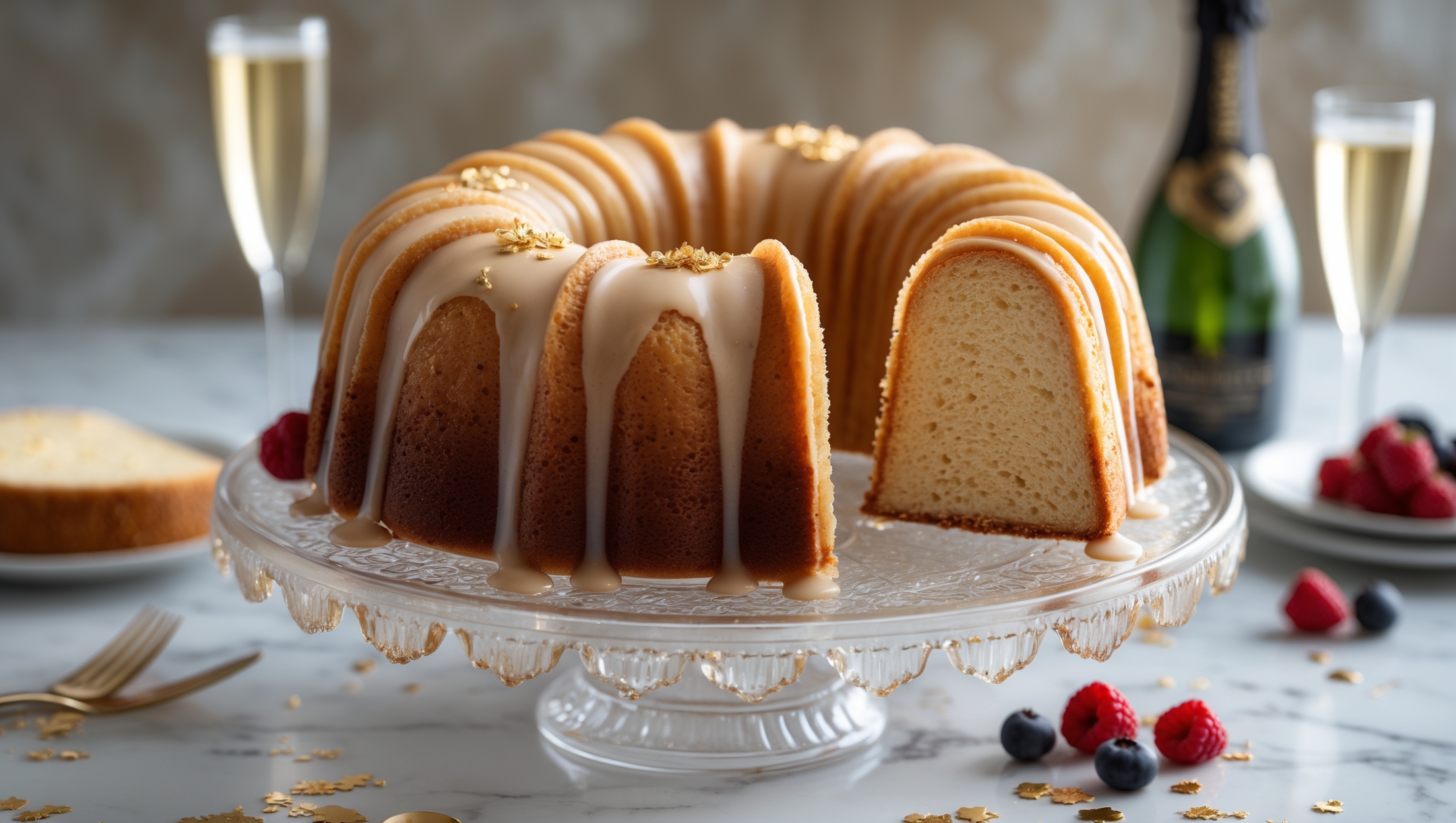
An elegant champagne bundt cake photographed in soft natural light, showcasing its golden exterior and perfect ring shape with deep ridges capturing the champagne glaze that drips tantalizingly down its sides. A cross-section view reveals the cake's fine, moist crumb structure with tiny air pockets created by the champagne's carbonation. The cake sits proudly on a vintage crystal cake stand, with a few fresh berries and edible gold flakes scattered around as garnish. In the background, a blurred champagne flute and an uncorked bottle suggest celebration, while the warm golden tones of the cake contrast beautifully against a cool marble surface, highlighting the cake's luxurious appeal.

Ingredients

<ul class="ingredients-main-list"><li class="ingredients-single-item">340g unsalted butter, softened</li><li class="ingredients-single-item">400g granulated sugar</li><li class="ingredients-single-item">4 large eggs, room temperature</li><li class="ingredients-single-item">2 tsp vanilla extract</li><li class="ingredients-single-item">375g all-purpose flour</li><li class="ingredients-single-item">2 tsp baking powder</li><li class="ingredients-single-item">1/2 tsp salt</li><li class="ingredients-single-item">240ml champagne or sparkling wine, room temperature and slightly flat</li><li class="ingredients-single-item">For the glaze:</li><li class="ingredients-single-item">150g powdered sugar, sifted</li><li class="ingredients-single-item">3-4 tbsp champagne</li><li class="ingredients-single-item">Optional: 1 tbsp unsalted butter, melted</li><li class="ingredients-single-item">Optional: edible gold dust or gold sprinkles for decoration</li></ul>

Equipment

<ul class="equipment-main-list"><li class="equipment-single-item">25cm (10-inch) bundt pan</li><li class="equipment-single-item">Stand mixer or hand electric mixer</li><li class="equipment-single-item">Cooling rack</li></ul>
BAKE SMARTER

Kitchen Converter

Quickly switch between common baking units without leaving the recipe.

Convert
Result—

Volume uses US cups, tablespoons, and teaspoons. Converting weight to volume depends on the ingredient.

Directions

<ol class="no-list-style"><li class="MethodStepper"><h4 class="step-title">Step 1</h4>Begin by allowing your champagne to sit at room temperature for 30-60 minutes so it becomes slightly flat. This prevents too much carbonation from affecting the cake structure. Meanwhile, preheat your oven to 175°C (350°F) and thoroughly grease and flour your bundt pan, ensuring you get into all the crevices – this is crucial for clean release later.</li><li class="MethodStepper"><h4 class="step-title">Step 2</h4>In your stand mixer fitted with the paddle attachment, beat the softened butter on medium speed until creamy, about 1 minute. Gradually add the sugar and continue beating for 4-5 minutes until light and fluffy. This extended creaming process incorporates air into the batter, which will give your cake its tender, velvety crumb.</li><li class="MethodStepper"><h4 class="step-title">Step 3</h4>Add the eggs one at a time, beating well after each addition. Scrape down the sides of the bowl periodically to ensure even mixing. After all eggs are incorporated, beat in the vanilla extract until just combined.</li><li class="MethodStepper"><h4 class="step-title">Step 4</h4>In a separate bowl, whisk together the flour, baking powder, and salt. With the mixer on low speed, add the dry ingredients to the butter mixture in three parts, alternating with two additions of champagne. Begin and end with the flour mixture (flour-champagne-flour-champagne-flour). Mix each addition until just combined – overmixing will develop too much gluten and result in a tough cake.</li><li class="MethodStepper"><h4 class="step-title">Step 5</h4>Pour the batter into your prepared bundt pan, smoothing the top with a spatula. Gently tap the pan on the counter a few times to release any air bubbles. Bake in the preheated oven for 50-55 minutes, or until a skewer inserted into the cake comes out clean and the top springs back when lightly touched.</li><li class="MethodStepper"><h4 class="step-title">Step 6</h4>Allow the cake to cool in the pan for exactly 10 minutes – this timing is important. Too short and the cake may break; too long and it might stick. After 10 minutes, invert the cake onto a wire cooling rack and allow it to cool completely before glazing.</li><li class="MethodStepper"><h4 class="step-title">Step 7</h4>For the champagne glaze, sift the powdered sugar into a bowl to remove any lumps. Slowly add 3 tablespoons of champagne, whisking continuously until smooth. For a richer glaze, add the optional melted butter. The glaze should be thick enough to coat the back of a spoon but still pourable – add more champagne or powdered sugar to adjust consistency as needed.</li><li class="MethodStepper"><h4 class="step-title">Step 8</h4>Place the cooled cake on a wire rack over a baking sheet (to catch drips). Pour the glaze evenly over the top of the cake, allowing it to flow naturally down the sides. If desired, sprinkle with edible gold dust or gold sprinkles while the glaze is still wet. Allow the glaze to set for at least 30 minutes before serving.</li><li class="MethodStepper"><h4 class="step-title">Step 9</h4>For the best flavor, let the cake rest for a few hours before serving – this allows the champagne flavor to fully develop. Store any leftover cake in an airtight container at room temperature for up to 3 days, or refrigerate for up to a week. Bring to room temperature before serving for the best texture and flavor experience.</li></ol>
Nutrition Facts (per serving)

🍽️ Serving Size: 1 serving
🔥 Calories: 385 calories
🥑 Fat: 21 g
🧈 Saturated Fat: 13 g
🍞 Carbohydrates: 45 g
🍭 Sugar: 32 g
🍗 Protein: 4 g
🫀 Cholesterol: 105 mg
🧂 Sodium: 220 mg

Chef’s Notes

A few helpful details for making this recipe.

Can I use prosecco or other sparkling wines instead of champagne?

Yes, any sparkling wine works beautifully in this recipe. Prosecco, cava, or even a sparkling rosé can be substituted for champagne. Each offers slightly different flavour notes - prosecco tends to be fruitier, while cava provides more citrus notes.

Why is my bundt cake sticking to the pan despite greasing it?

Bundt pans require thorough greasing of all ridges and crevices. Use butter and flour, or a baking spray with flour. Allow the cake to cool for exactly 10 minutes before turning out - too short and it may break, too long and it will stick.

What occasions are best for serving a champagne-infused cake?

This elegant dessert is perfect for milestone celebrations like weddings, anniversaries, New Year's Eve, engagement parties, or elegant brunch gatherings. The subtle champagne flavour and sophisticated appearance make it ideal for any special occasion.

Want to try something else in ...

More recipes you might like

Keep exploring with more recipes from What's Baking.