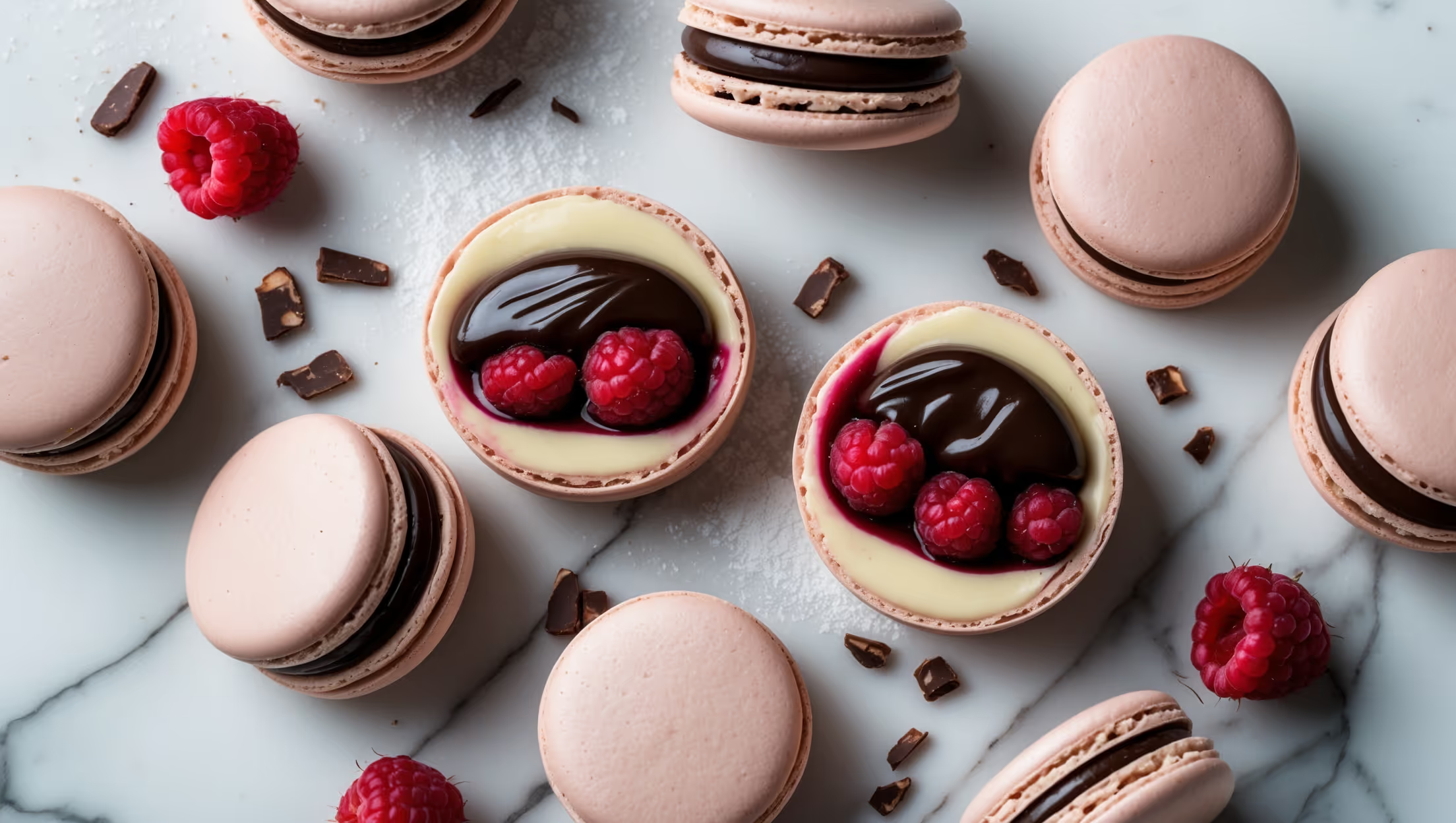
Directions
<ol class="no-list-style"><li class="MethodStepper"><h4 class="step-title">Step 1</h4>Begin by preparing your workspace and ingredients. Line two baking trays with silicone mats or parchment paper. Ensure all your ingredients are measured precisely using a digital scale - macaron success depends on exact measurements. If your egg whites haven't been aged, leave them at room temperature for at least an hour before beginning.</li><li class="MethodStepper"><h4 class="step-title">Step 2</h4>Sift together the almond flour, powdered sugar, and cocoa powder through a fine-mesh sieve into a large bowl. Discard any large pieces that don't pass through. This step is crucial for achieving smooth macaron tops. Sift twice if necessary.</li><li class="MethodStepper"><h4 class="step-title">Step 3</h4>In a completely clean and dry bowl of your stand mixer fitted with the whisk attachment, add the room temperature egg whites. Begin whisking on medium speed until the whites become frothy, then add the cream of tartar. The cream of tartar stabilizes the egg whites, helping to create a more stable meringue.</li><li class="MethodStepper"><h4 class="step-title">Step 4</h4>Gradually add the granulated sugar while continuing to whisk. Once all sugar is incorporated, increase to high speed and whisk until stiff peaks form. The meringue should be glossy and when you lift the whisk, the peak should stand straight up with just a slight curl at the tip. Be careful not to overwhip, as this will make the macarons hollow.</li><li class="MethodStepper"><h4 class="step-title">Step 5</h4>Add the vanilla extract and red gel food coloring. The color should be quite vibrant as it will lighten once baked. Whisk just until incorporated - no more than 3-5 seconds.</li><li class="MethodStepper"><h4 class="step-title">Step 6</h4>Add one-third of the dry ingredients to the meringue and fold gently with a silicone spatula. Once mostly incorporated, add the remaining dry ingredients and continue to fold. This technique is called "macaronage" and is perhaps the most critical step to master. Fold by scraping around the bowl and cutting through the middle, rotating the bowl as you go.</li><li class="MethodStepper"><h4 class="step-title">Step 7</h4>Continue folding until the batter reaches the proper consistency - it should flow like lava and when you lift some batter with your spatula and drop it back, it should incorporate within 15-20 seconds. To test, draw a figure eight with the batter - it should disappear slowly. Undermixing will result in peaked tops; overmixing will create flat, footless macarons.</li><li class="MethodStepper"><h4 class="step-title">Step 8</h4>Transfer the batter to a piping bag fitted with a round tip. Holding the bag perpendicular to the baking tray, pipe 3-4cm circles, spacing them about 3cm apart. The batter should spread slightly but maintain its circular shape. Once all shells are piped, firmly tap the baking sheets against the counter 3-4 times to release any air bubbles.</li><li class="MethodStepper"><h4 class="step-title">Step 9</h4>Allow the macarons to rest at room temperature for 30-45 minutes, or until a skin forms on top. You should be able to lightly touch the surface without batter sticking to your finger. This resting period is essential for developing the characteristic "feet" when baking.</li><li class="MethodStepper"><h4 class="step-title">Step 10</h4>While the shells are resting, preheat your oven to 150°C. Bake one tray at a time in the center of the oven for 14-16 minutes. The macarons are done when they feel firm to a gentle touch and don't wiggle on their feet. Allow them to cool completely on the tray before attempting to remove them.</li><li class="MethodStepper"><h4 class="step-title">Step 11</h4>For the cream cheese filling, beat the softened cream cheese and butter together until smooth and fluffy, about 2 minutes. Add the sifted powdered sugar gradually, mixing on low speed to avoid a sugar cloud. Once incorporated, increase the speed and beat for 2-3 minutes until light and fluffy. Add the vanilla extract and salt, then beat for another minute.</li><li class="MethodStepper"><h4 class="step-title">Step 12</h4>Transfer the filling to a piping bag fitted with a round tip. Once the macaron shells are completely cool, pipe a generous amount of filling onto the flat side of one shell, then sandwich with another shell, gently pressing to spread the filling to the edges.</li><li class="MethodStepper"><h4 class="step-title">Step 13</h4>For the best flavor and texture, place the assembled macarons in an airtight container and refrigerate for 24 hours before serving. This "maturation" process allows the shells to soften slightly and the flavors to meld. Bring to room temperature for about 30 minutes before serving for the best taste and texture experience.</li></ol>