Directions
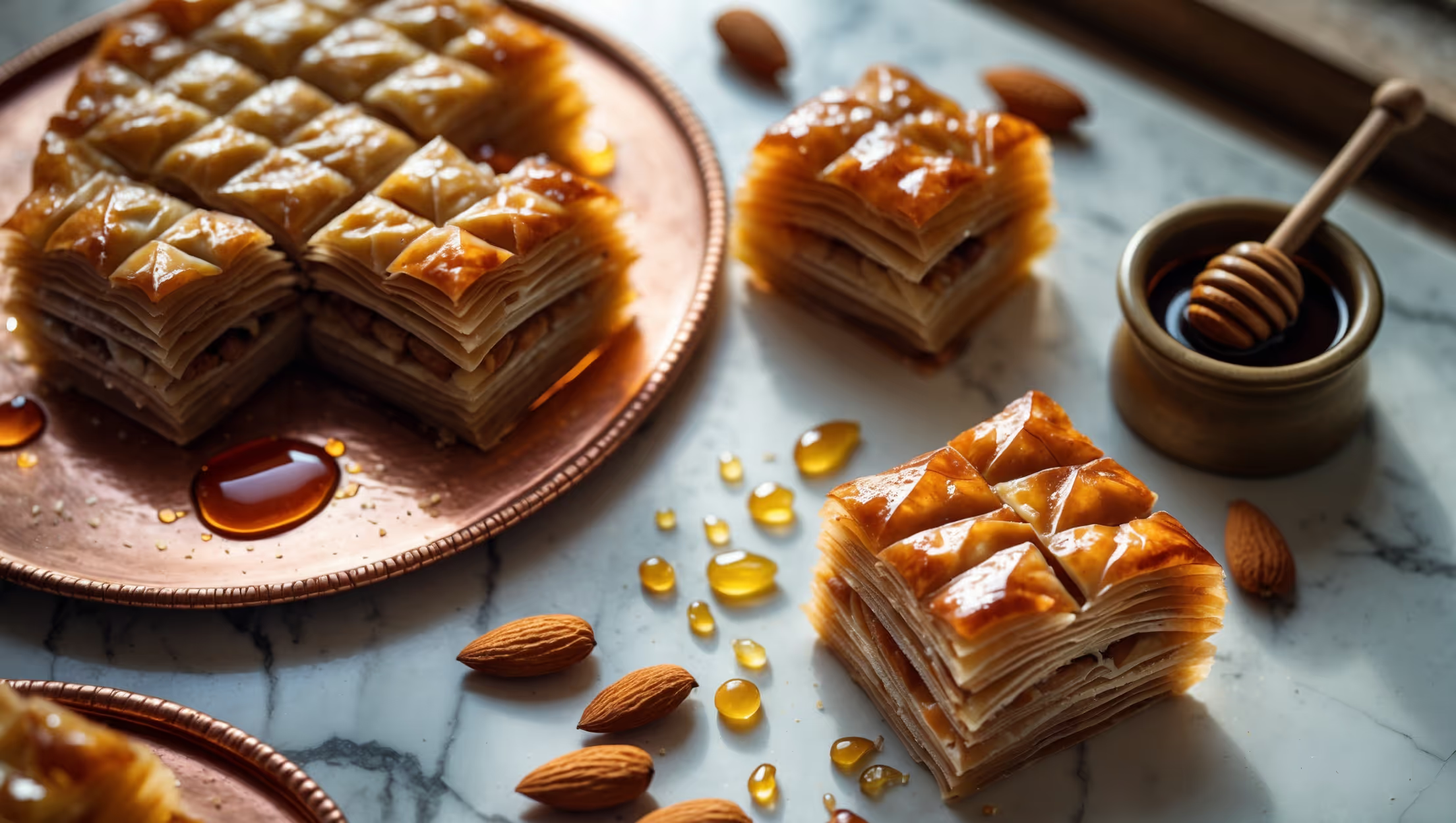
<ol class="no-list-style"><li class="MethodStepper"><h4 class="step-title">Step 1</h4>Begin by preparing your workspace. Preheat your oven to 160°C (fan)/180°C/350°F. Melt the butter in a small saucepan over low heat or in the microwave and set aside to cool slightly. Butter your baking dish generously - this will help create those perfectly crisp bottom layers.</li><li class="MethodStepper"><h4 class="step-title">Step 2</h4>For the filling, combine the ground almonds, sugar, cinnamon, cardamom, cloves, and orange zest in a large bowl. Mix thoroughly to ensure the spices are evenly distributed throughout the nuts. The orange zest adds a subtle citrus note that balances the sweetness and complements the honey.</li><li class="MethodStepper"><h4 class="step-title">Step 3</h4>Unwrap your phyllo pastry and cover with a slightly damp kitchen towel to prevent it from drying out as you work. Phyllo dries quickly and becomes brittle, so keep it covered between each use. If it tears slightly, don't worry - the layers will hide any imperfections.</li><li class="MethodStepper"><h4 class="step-title">Step 4</h4>Layer 6-8 sheets of phyllo in the bottom of your prepared baking dish, brushing each sheet generously with melted butter before adding the next. The butter between each layer is crucial - it helps create those distinct, flaky layers that baklava is known for. Allow excess phyllo to hang over the edges for now.</li><li class="MethodStepper"><h4 class="step-title">Step 5</h4>Sprinkle about 1/3 of your almond mixture evenly over the phyllo base. Add another 4-5 sheets of phyllo on top, buttering each layer as before. Repeat with another 1/3 of the nut mixture, another 4-5 buttered phyllo sheets, and then the final 1/3 of nuts.</li><li class="MethodStepper"><h4 class="step-title">Step 6</h4>Top with the remaining phyllo sheets, buttering each layer generously. For the top layer, make sure to brush it particularly well with butter as this will give your baklava its beautiful golden color. Trim any overhanging phyllo with scissors or a sharp knife and tuck the edges down into the pan.</li><li class="MethodStepper"><h4 class="step-title">Step 7</h4>Before baking, use a sharp knife to cut your baklava into diamond or square shapes. This is essential to do now rather than after baking - the delicate layers will shatter if you try to cut them when crisp. Cut straight down through all layers, making sure to reach the bottom of the dish. Traditional baklava features diamond shapes, which you can achieve by cutting straight lines lengthwise, then diagonal lines across.</li><li class="MethodStepper"><h4 class="step-title">Step 8</h4>Bake in the preheated oven for 45-50 minutes, until the top is crisp and golden amber in color. The long, relatively low baking temperature ensures that all layers cook evenly without burning the top before the middle is done.</li><li class="MethodStepper"><h4 class="step-title">Step 9</h4>While the baklava is baking, prepare the syrup. Combine the honey, sugar, water, cinnamon stick, and lemon peel in a saucepan. Bring to a boil, then reduce heat and simmer gently for about 15 minutes until slightly thickened. The syrup shouldn't be too thick as it needs to penetrate all the layers. Remove from heat and stir in the vanilla extract and lemon juice. The acid in the lemon juice prevents crystallization and balances the sweetness.</li><li class="MethodStepper"><h4 class="step-title">Step 10</h4>When the baklava comes out of the oven, immediately pour the hot syrup evenly over the hot pastry. You'll hear a satisfying sizzle as the syrup hits the hot pastry - this is perfect! The contrast of temperatures helps the syrup to be absorbed properly. Make sure to get syrup into all the cut lines.</li><li class="MethodStepper"><h4 class="step-title">Step 11</h4>Allow the baklava to cool completely in the pan, uncovered, for at least 4-6 hours or preferably overnight. This resting time is non-negotiable - it allows the syrup to be fully absorbed and the flavors to meld together. Patience results in perfectly textured baklava that's neither soggy nor dry.</li><li class="MethodStepper"><h4 class="step-title">Step 12</h4>Once completely cooled, follow your pre-cut lines and slice all the way through again with a sharp knife. Serve at room temperature. Your almond baklava will keep well in an airtight container at room temperature for up to 2 weeks, though the texture is best within the first week.</li></ol>