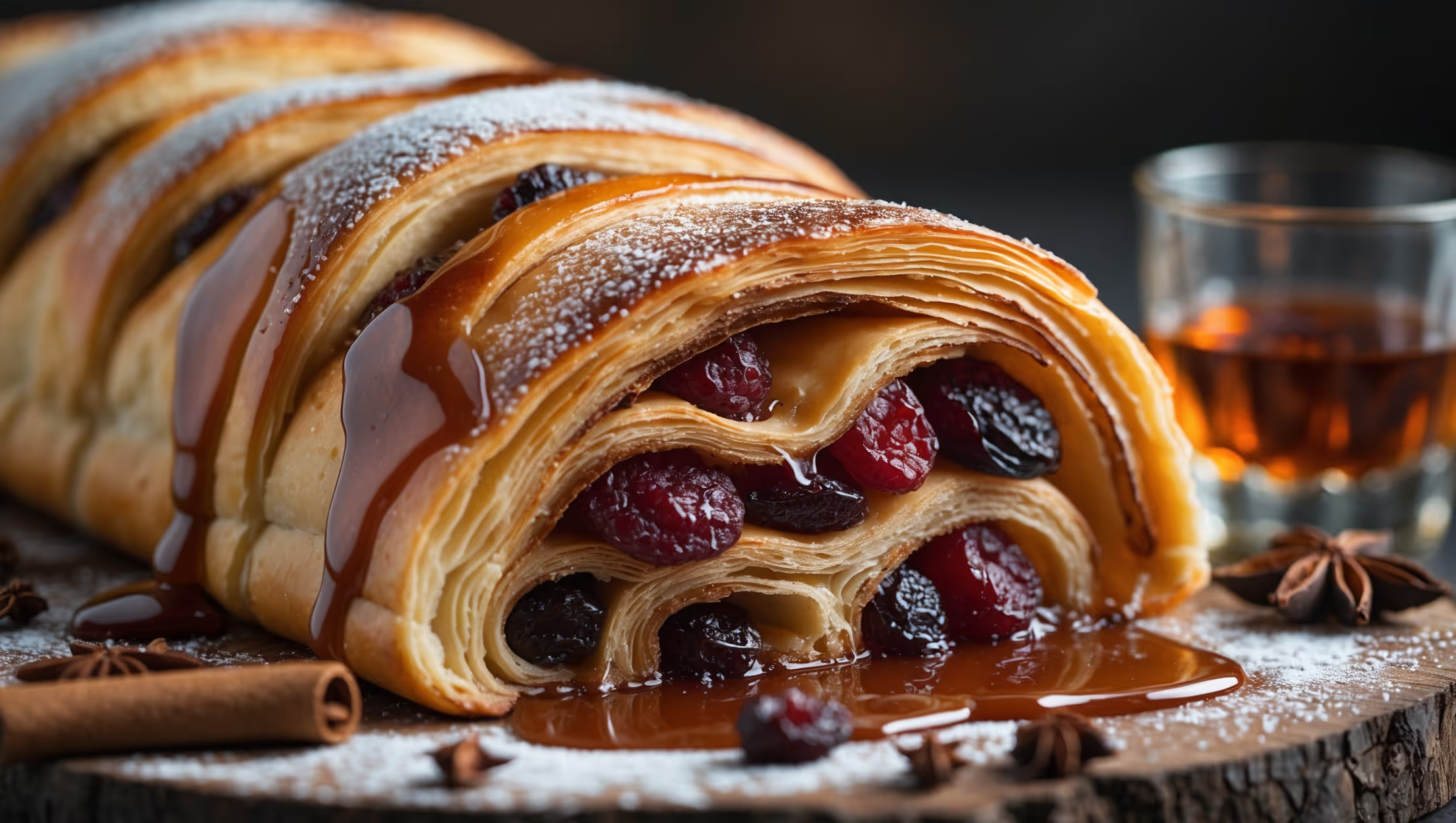
Directions
<ol class="no-list-style"><li class="MethodStepper"><h4 class="step-title">Step 1</h4>Begin by preparing the fruit filling the night before. Chop any larger dried fruits into small pieces, then place all dried fruits in a medium bowl. Pour the whiskey over the fruit, add the brown sugar, orange zest, cinnamon, and nutmeg. Stir well to combine, cover with plastic wrap, and leave to macerate overnight at room temperature. The alcohol will soften and plump the fruits while infusing them with rich flavor.</li><li class="MethodStepper"><h4 class="step-title">Step 2</h4>For the Danish dough, combine the flour, yeast, sugar, and salt in a large bowl or the bowl of your stand mixer. In a separate bowl, whisk together the eggs, warm milk (around 38°C, warm but not hot to preserve the yeast), and vanilla extract. Add the wet ingredients to the dry and mix until a shaggy dough forms. If using a stand mixer, knead with the dough hook for 5 minutes; if by hand, turn onto a lightly floured surface and knead for 8-10 minutes until smooth and elastic. The proper development of gluten at this stage is crucial for lamination success.</li><li class="MethodStepper"><h4 class="step-title">Step 3</h4>Shape the dough into a rectangle, wrap in plastic, and refrigerate for at least 30 minutes. Meanwhile, prepare the butter block by placing the cold butter between two sheets of parchment paper and beating it with a rolling pin until malleable but still cold. Shape into a 20×15cm rectangle, rewrap, and refrigerate until firm but pliable (about 15 minutes).</li><li class="MethodStepper"><h4 class="step-title">Step 4</h4>Roll the chilled dough into a 30×20cm rectangle on a lightly floured surface. Place the butter block on one half of the dough, leaving a 1cm border. Fold the other half over the butter and seal the edges well by pinching. This encases the butter completely which is essential for creating those beautiful flaky layers.</li><li class="MethodStepper"><h4 class="step-title">Step 5</h4>Now for the first turn: Roll the dough into a 45×20cm rectangle, keeping the edges straight (use your hands to square them if needed). Fold the dough like a letter: fold the bottom third up, then the top third down. Rotate the dough 90 degrees (so the open edge is on the right). Wrap and refrigerate for 30 minutes. The cold rest periods are non-negotiable – they allow the gluten to relax and the butter to firm up again.</li><li class="MethodStepper"><h4 class="step-title">Step 6</h4>Repeat the rolling, folding, and chilling process two more times (three turns total). After the final turn, wrap the dough well and refrigerate for at least 2 hours or overnight. This patience results in perfectly laminated dough with distinct butter layers.</li><li class="MethodStepper"><h4 class="step-title">Step 7</h4>When ready to shape, drain any excess liquid from the soaked fruit mixture. Preheat your oven to 190°C and line a baking sheet with parchment paper. Roll the dough into a large rectangle about 40×30cm and 3-4mm thick. Cut into 8 equal squares.</li><li class="MethodStepper"><h4 class="step-title">Step 8</h4>Place about 1-2 tablespoons of the whiskey-soaked fruit mixture in the center of each square. Fold two opposite corners of each square into the center, overlapping slightly, to form a diamond shape. Press firmly to seal. Alternatively, fold all four corners into the center for a different design. The pastry should cradle the filling while allowing some fruit to peek through.</li><li class="MethodStepper"><h4 class="step-title">Step 9</h4>Place the shaped Danishes on the prepared baking sheet, leaving space between them. Cover loosely with a clean kitchen towel and allow to proof at room temperature for 30-45 minutes until slightly puffy. The pastries should look visibly expanded but not doubled in size.</li><li class="MethodStepper"><h4 class="step-title">Step 10</h4>Bake in the preheated oven for 20-25 minutes or until deeply golden brown. The high sugar content in the dough can cause quick browning, so check after 15 minutes – if they're browning too quickly, cover loosely with foil. The internal temperature should reach 90°C when fully baked.</li><li class="MethodStepper"><h4 class="step-title">Step 11</h4>While the Danishes are baking, prepare the glaze by whisking together the powdered sugar, whiskey, orange juice, vanilla extract, and cinnamon until smooth. The glaze should be thick enough to coat the back of a spoon but still pourable – adjust with more powdered sugar or liquid as needed.</li><li class="MethodStepper"><h4 class="step-title">Step 12</h4>Allow the Danishes to cool for 10 minutes on the baking sheet, then transfer to a wire rack. While still warm but not hot, drizzle the infused glaze generously over each pastry, allowing it to seep slightly into the layers. The warmth helps the glaze to set with a beautiful sheen. Serve warm or at room temperature. These Danishes are best enjoyed the day they're made but will keep in an airtight container for up to 2 days. You can refresh them briefly in a 160°C oven for 5 minutes before serving.</li></ol>